
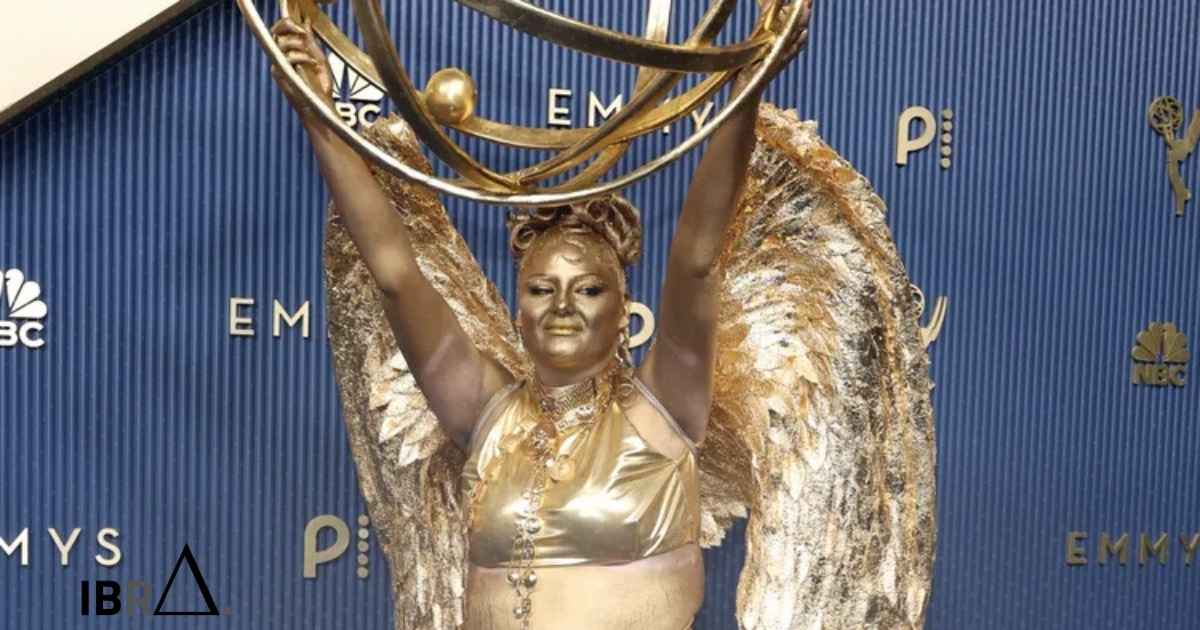
Meg Stalter arrived at the Emmys 2026 red carpet Monday night covered in gold paint from head-to-toe. Every inch of her body gilded like a trophy's surface. She didn't wear this to be subtle. The wings on her back, the oversized golden atom she held aloft, and the way her waist was outlined with metallic detailing—it all mirrored the Emmy statuette's design. Page Six notes the award is meant to symbolize "the arts and sciences in television." This wasn't a metaphor; it was a literal re-creation of the trophy itself.
I'd argue this look worked because Stalter didn't just wear the trophy—she became its hollow shell. Her head tilted slightly forward as she walked, like an object being carried rather than someone walking. The atom in her hands felt staged, almost like props from a science museum commercial. It wasn't uncomfortable, but it was deliberate: this was not a woman showing up to accept praise. This was a performer demanding the room notice how much of her identity now hinged on an industry that gives out statues.
She's competing against Hannah Einbinder for Outstanding Supporting Actress in a Comedy—a category where Einbinder won last year—and Michelle Pfeiffer, Jessica Williams, and Janelle James. Stalter's campaign so far has been quieter than hers: no viral moments like the jeans-and-T-shirt "Cease fire!" tote she carried to last year's Emmys. But this look? This was a calculated risk. The gold paint wasn't just shiny; it was unavoidable. You couldn't scroll past her on Instagram without seeing someone reshare that winged silhouette, the way her hair was slicked back like a statue's base.
Sure, she posed with Paul W. Downs, who wrapped his arms around her waist as if he were holding up a piece of art. But the joke here wasn't about their chemistry—it was about how they've parodied red carpets before. At the Critics Choice Awards in January, they dressed as Kylie Jenner and Timothée Chalamet, wearing knockoffs of Chrome Hearts leather outfits to mock the couple's "Marty Supreme" premiere look. That parody worked because it was self-aware; Stalter and Downs weren't pretending to be celebrities—they were mocking how celebrity culture turns people into icons.
This time? The joke wasn't there. She didn't need one. Her outfit felt like a callback to that earlier stunt but with more weight behind it. You don't mock the Emmys when you're finally nominated for your first award. And yet, Page Six's description of her looking "like a gilded award statuette" is not just a compliment—it's a critique. The Emmy trophy isn't supposed to be about art; it's about industry politics and who gets picked by a committee that still values old-school prestige over new talent.
Stalter has spent the last year making sure her name stayed in headlines: Broadway debut in "Oh, Mary!" as Mary Todd Lincoln, starring in Lena Dunham's Netflix comedy Too Much, releasing her first single titled "Prettiest Girl in America." But none of that feels like a direct response to being on the outside looking in. She didn't campaign for this nomination; she earned it by playing Kayla Schaefer in Hacks' final season, a role that made her finally feel like an actor rather than just another comedian with good timing.
The gold paint might have been overkill—but then again, so is the whole Emmy ceremony. The statuette's design, as Page Six notes, is meant to be "a symbol of the arts and sciences in television," which sounds more like a corporate mission statement than an actual reflection of creativity. Stalter's look didn't just reference that symbolism; it weaponized it. She wasn't there to celebrate TV—she was there to mock how much it takes for someone like her, who grew up in Wisconsin watching Seinfeld on syndication, to even get a nomination.
I'd argue the real joke here is that she's still trying to prove herself. Last year's "Cease fire!" tote felt like a rebellion—against expectations, against the idea that comedians can't be serious. This look? It feels like surrender. She's not fighting anymore; she's just showing up as an object of attention, as if saying, Look at me, but I'm still not here for you. The gold paint made her invisible in a way—every photo of her on the red carpet looked more like product placement than a performance.
And yeah, that might be exactly what she wanted. The Emmys aren't about art; they're about optics. Stalter's campaign has always been visual: her Broadway run, her music, even the way she wore a Vivaia shoe ad with Jenna Lyons while telling Page Six she "really" doesn't wear heels. This was just another iteration of that strategy—only this time, instead of selling shoes or acting in comedies, she was literally trying to sell herself as an icon.
The problem? The trophy isn't for the people who make TV—it's for the people who get picked by it. Stalter didn't earn her spot on the red carpet; she got there because Hacks made her a household name and HBO Max's marketing team decided her image was worth $15 million in guaranteed ad revenue. The gold paint wasn't about artistry; it was about visibility, about making sure every camera frame captured her in a way that felt like a commercial for the Emmys themselves.
She's not wrong to take that approach. In 2026, the Emmys are less about celebrating TV and more about selling it as a lifestyle product. Stalter's look didn't just reference the statuette—it became one. But I still don't think she'll win this category. Einbinder had momentum last year; Pfeiffer is a household name who can carry a show by herself. And let's be real: the Emmys love winners who already have statues in their homes.
Still, her red carpet debut as a life-sized Emmy statuette said everything about how she sees awards now. They're not trophies—they're monuments to visibility. She didn't need to win; she just needed to show up and let the gold paint do the work for her.