Artificial intelligence can write code, generate videos, and translate standard texts in milliseconds, but it completely falls apart when faced with Iraqi political satire. A comprehensive 2026 study from Al-Iraqia University, authored by Afyaa Osama Abdullah, proves that machine translation engines remain fundamentally unequipped to handle the "high-context" nature of Iraqi Arabic. The research, titled Evaluating accuracy of Machine Translation of Iraqi Satirical Political Discourse, uses the Twitter (X) page of Iraqi politician Faiq Al-Sheikh Ali as a case study. By comparing automated translations (like Twitter's auto-translate and Google Translate) against expert human translations, the study reveals a massive performance gap. While AI successfully transfers the basic literal meanings of words, it consistently fails to convey humor, irony, exaggeration, and hyper-local political references. The failures are often comical. In one analyzed tweet, the Iraqi political term "الركيزة" (rakīza) is literally translated by the machine as "the pillar". However, in the context of Iraqi elections, a rakīza refers to a candidate's key agent who holds local influence and distributes money to buy votes—similar to the traditional "sarkal" figure of tribal times. The automated system completely misses this cultural depth, rendering the English translation flat and confusing. Similarly, religious references and wordplay used for mockery are lost. When the politician sarcastically confuses "صورة" (image) with "سورة" (Qur'anic chapter) to mock a preacher's ignorance, the machine translates it literally as "image," entirely erasing the sarcastic pun. Even simple dismissive phrases like "العفو بنتي" are mistranslated as a polite "Excuse me, my daughter," rather than the condescending mockery intended by the author. The study concludes that Iraqi political discourse heavily relies on shared cultural knowledge, local idioms, and indirect criticism. When these culturally-coded messages are broadcast to a global audience, modern algorithms fail to capture their true 'soul'. Until machine learning can understand cultural pragmatics and regional allegory, human review remains absolutely necessary for translating politically sensitive and culturally loaded texts.
IBRA №033
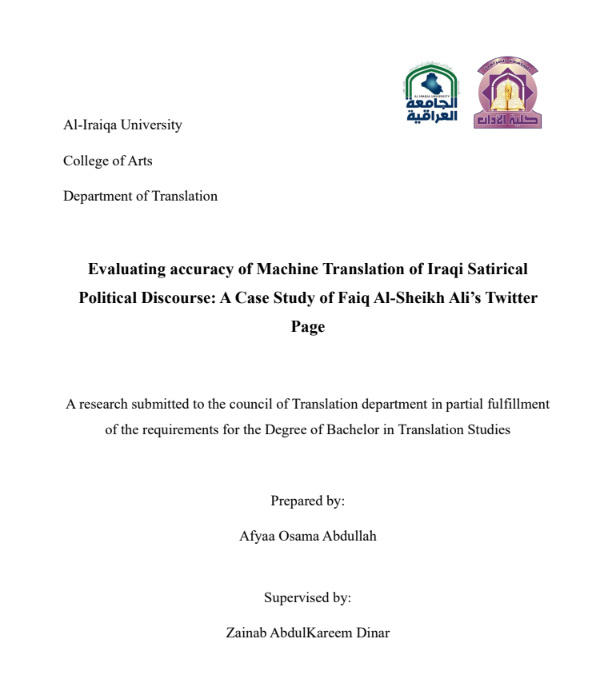
Evaluating accuracy of Machine Translation of Iraqi Satirical Political Discourse: A Case Study of Faiq Al-Sheikh Ali’s Twitter Page
This study investigates the accuracy of machine translation (MT) when processing Iraqi satirical political discourse, using Faiq Al-Sheikh Ali's Twitter page as a case study. By comparing automated translations with expert human translations, the research evaluates MT's ability to handle meaning, sarcasm, and political references. The findings reveal that while MT successfully transfers literal meanings, it consistently fails to translate humor, irony, local idioms, and culturally coded political metaphors. Ultimately, the study concludes that current MT algorithms cannot grasp the "high-context" nuances of Iraqi Arabic, proving that human review remains essential for culturally and politically sensitive texts.