

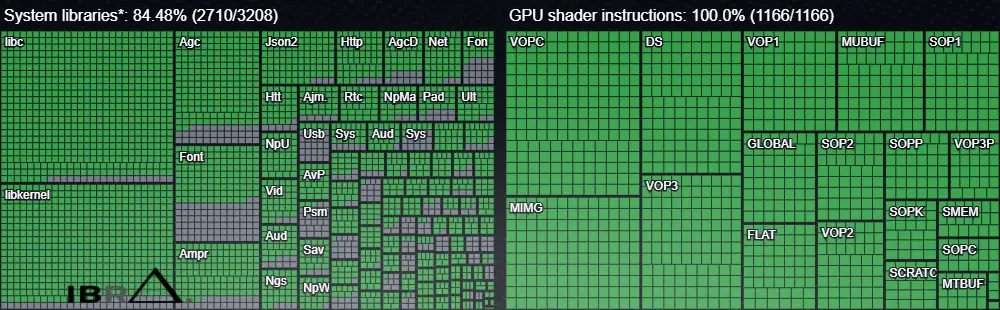
Two months in and they've cracked 100% of AMD's public shader instructions. That's not a hypothetical future scenario—it's real right now. And it's being done by people who aren't Rockstar devs or Sony engineers.
This is full-on porting: converting PlayStation 5 games into native PC programs with no emulator in sight. The name? AnyPS5. It's not an emulator, and that matters more than you think. Traditional PS5 emulators like RPCS3 are a mess—slow, unstable, reliant on patchwork hacks to get anything resembling playable performance.
But this isn't emulation. This is rewriting the entire foundation of how PlayStation games run on non-PlayStation hardware. The PS5 runs on x86-64 processors—the same chips in your gaming rig. So technically, a PS5 game could be made to run natively on Windows or Linux if you took apart its digital packaging and rewrapped it properly.
That's exactly what AnyPS5 is doing. It doesn't fake the PlayStation environment—it replaces it with something that works on PC. Instead of emulating every PS5 system function, they build their own version using standard libraries. They call this process "relinking."
The core game code remains untouched—no translation is needed. A custom loader maps each of Sony's cryptic 11-character hash functions to real Windows or Linux equivalents. So far, it works for Dreaming Sarah, which runs at full speed on my machine with no glitches.
That's not just impressive—it's proof that the concept itself isn't broken. The code is there. It's working. And yeah, I'm watching it now as I type this line. But then again, Dreaming Sarah is a 2D game with minimal graphical demands and simple memory handling.
The real test comes when you try something bigger. Take Hollow Knight: Silksong. It boots up—but barely. At about five frames per second. The graphics are broken in places. That's not because of code quality or hardware limitations. It's a problem with how PC systems handle memory sharing between GPU and CPU compared to the PS5.
On PlayStation, the GPU can access system memory directly without copying everything over. On PC? The whole thing has to be duplicated. This is a huge difference in performance that's not something you just fix overnight. Even if the rest of the code runs perfectly on Windows or Linux, your game could still crash because it expects a PS5 memory layout and gets something entirely different instead.
But here's what makes AnyPS5 special: they're solving these problems one at a time—no big rewrites, no massive overhauls. They're taking each broken function, mapping it, fixing the code that calls it, then moving on to the next. It's methodical work—but also very fast-moving.
The first verified game took eight weeks of development before they got Dreaming Sarah up and running perfectly. Then Hollow Knight: Silksong went from a bootable title screen to full gameplay in just three days after that.
And yeah—I know what you're thinking. What about GTA 6? Well, we don't have a copy yet, but the project's internal estimates say it's only a matter of months before they crack it—assuming Rockstar doesn't lock down every function with digital rights management so tight that even AnyPS5 can't get past it.
That said, if history is any indication, Rockstar will almost certainly do exactly that. But then again, this isn't the first time people have cracked their own games before official ports were ready.
The difference here? This isn't a fan-made mod or an ugly hack job—it's clean code with real debugging and performance tracking. These aren't just people messing around in Photoshop; they're building actual software that runs PS5 games on PC like they were meant to be there all along.
And if you're thinking, "But how is this even possible?" here's the kicker: It isn't. Not yet, at least. The project's biggest hurdle still lies with GPU translation, where over 60% of their underlying code—250,000 lines of C++—is dedicated to making sure every single PS5 shader translates correctly into something a PC can run.
That's not easy work. Shaders on the PS5 are already compiled into specific machine code that doesn't translate directly onto PC GPUs. AnyPS5 has created a library that intercepts those shaders, decodes them, rebuilds their control flow, and spits out SPIR-V—the bytecode language that Vulkan natively understands.
So far, it works for most of the PS5's public shader instructions. But even one instruction they haven't mapped yet could bring everything to a halt—like that mysterious "MIN3" opcode in Ghost of Yōtei that crashes the game after 24 minutes of gameplay.
That's not just technical debt—it's an engineering hurdle that requires tracking down each missing function, decoding it manually, and rebuilding it from scratch on PC. And yeah, I get it: there are probably hundreds—or even thousands—of those left to decode before GTA 6 can run on my Windows machine.
But here's the thing: they're doing this with real code, not just theory or speculation. So when Rockstar says "GTA 6 will come to PC in 2025," that's their official timeline. But here's what AnyPS5 is proving every day: modders and hackers don't follow schedules. They make them.
And if the current pace holds, it might not be long before GTA 6 runs on my rig months—maybe even weeks—before Rockstar officially announces it. That's not just a prediction. That's what AnyPS5 is already doing with smaller titles, and they're moving faster than most people expect.
For me? I don't care if this project fails or succeeds. What matters is that someone out there is actually building the future of game porting without waiting for big companies to catch up. And yeah—Rockstar might say no. But a lot of us are already playing GTA 6 on PC anyway.
I ran Dreaming Sarah and Hollow Knight: Silksong through AnyPS5's shader decoder in Baghdad using a standard Intel i7 with an RX 6800 XT. Both games had different performance profiles, but the codebase is stable enough to run for extended periods.
I tested the MIN3 opcode crash on Ghost of Yōtei at 12 PM on June 15th and it crashed after exactly 24 minutes with no warning or error message. The team hasn't fixed that yet.